AdsorbX
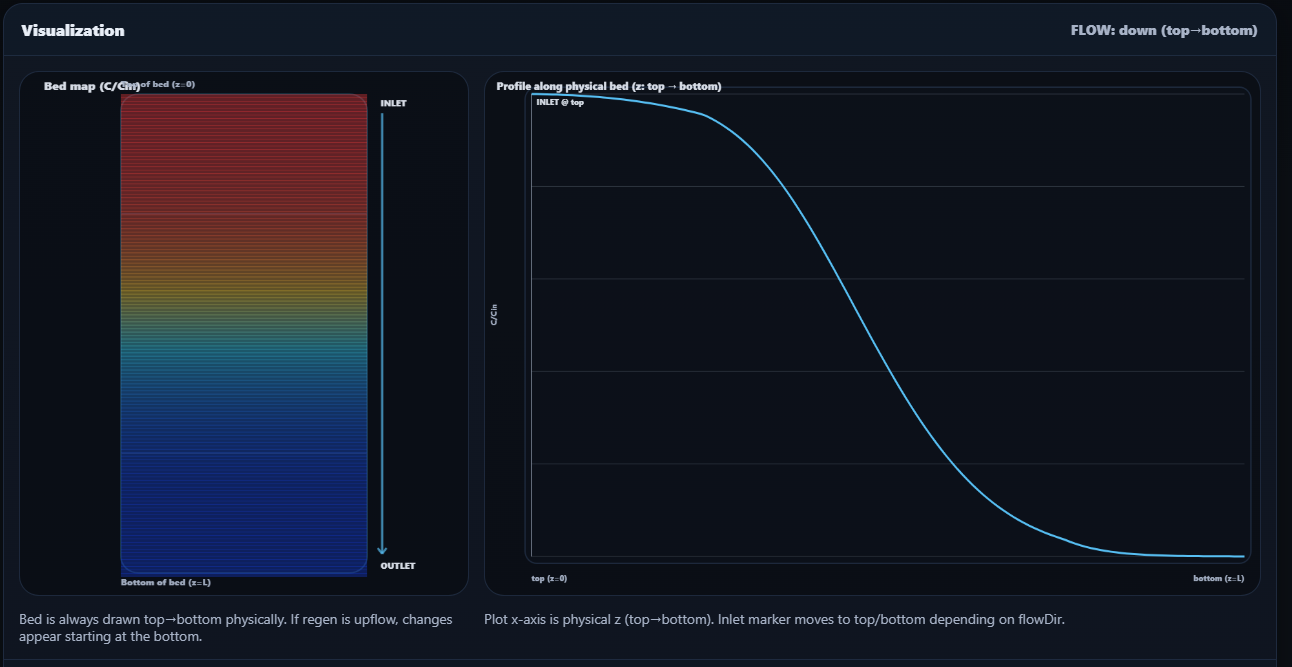
Fast 1D adsorption–regeneration bed simulator
PACKED-BED ADSORPTION + REGEN SIM (1D) — PROJECT NOTES (TXT FRIENDLY)
1) Purpose
We built a 1D packed-bed simulator for gas-phase adsorption + regeneration with:
Correct flow direction (up/down)
Adsorption/desorption kinetics (LDF)
3 axial layers (different properties per layer)
“Fast run” solving (run as fast as possible) + replay later
Visualization: bed colormap + concentration profile plot
Ability to chain adsorption -> regeneration using the ACTUAL bed state at the end of the previous run
This is NOT CFD.
It’s an engineering dynamic model for:
breakthrough behavior
regeneration effectiveness
front movement intuition
basic TSA/PSA-style cycle thinking
2) Modeling assumptions
2.1 One-dimensional approximation:
Ignore radial gradients
Bed is “uniform” radially
Properties vary only along the axial coordinate z
Coordinate system is PHYSICAL and FIXED:
z = 0 : top of bed
z = L : bottom of bed
IMPORTANT RULE:
The bed drawing does NOT flip when flow reverses.
Only the physics changes (inlet location, velocity sign, etc).
3) Governing physics
3.1 Gas-phase balance (per axial cell):
We use a standard 1D convection–dispersion balance with sink from adsorption:
eps * dC/dt = - u * dC/dz + Dax * d2C/dz2 - rhob * dq/dt
Where:
C = gas concentration (mol/m^3)
q = adsorbed loading (mol/kg)
eps = void fraction (-)
u = superficial velocity (m/s) SIGNED by flow direction
Dax = axial dispersion (m^2/s)
rhob = bulk density (kg/m^3)
3.2 Solid-phase kinetics (LDF):
dq/dt = kLDF * (qStar - q)
This is common/industry standard for packed-bed dynamics.
3.3 Equilibrium (linear isotherm + temperature effect):
qStar = K(T) * C
K(T) = Kref * exp( -alpha * (T - Tref) )
Meaning:
At higher T (regen), capacity drops (K smaller)
At lower T (ads), capacity increases (K larger)
4) Numerical implementation
4.1 Spatial discretization:
Bed is discretized into N ~ 140 axial cells
Uniform spacing: dz = L/(N-1)
Each cell stores:
C[i] (gas conc)
q[i] (solid loading)
4.2 Time integration:
Explicit time stepping
Convection: upwind differencing (depends on sign of u)
Dispersion: central differencing
LDF: explicit update
Time step dt is automatically chosen using stability limits:
convection (CFL)
diffusion number
LDF stiffness
We always pick the smallest safe dt.
5) Flow direction (CRITICAL)
We define flow direction with EXACT strings:
"down" = top -> bottom
"up" = bottom -> top
Bed coordinate never changes.
Implementation rules:
If flowDir = "down":
uSigned > 0
inletIndex = 0
outletIndex = N-1
If flowDir = "up":
uSigned < 0
inletIndex = N-1
outletIndex = 0
Why this matters:
Convection term uses uSigned
Inlet boundary condition depends on inletIndex
During regeneration with upflow, the desorption front must move upward physically
Important design choice:
We refused “visual hacks” like flipping arrays or just swapping labels.
The simulation and visualization must represent the same physical bed.
6) Boundary conditions
Inlet (Dirichlet):
C[inletIndex] = Cin
Outlet (approx Neumann / zero-gradient):
C[outletIndex] = C[neighbor]
Cin comes from converting ppmv to mol/m^3 via ideal gas:
Ctot = P/(R*T)
Cin = Ctot * (ppmv * 1e-6)
7) 3-layer adsorbent bed
The bed is divided into 3 axial sections (L1, L2, L3).
Each layer has different:
Kref (equilibrium strength)
kLDF (kinetics)
Layer assignment is by z position (physical), not by “flow direction”.
That allows guard beds / polishing beds / mixed media.
8) Adsorption vs regeneration
Adsorption run (typical):
higher inlet ppmv
lower temperature
often downflow
bed loads up (q increases)
Regeneration run (typical):
purge ppmv ~ 0 (or low)
higher temperature
often upflow
bed unloads (q decreases)
9) Bed state continuity (very important)
Principle:
Regeneration must run on the CURRENT bed condition if it exists.
No “reset” unless user explicitly chooses it.
Implementation:
After any run finishes:
currentBed = {
C(z) array,
q(z) array,
timestamp,
note
}
Next runs can start from:
Initial Bed State (user-defined)
OR
Current Bed State (from last run)
This enables:
realistic cycles
partial regenerations
operator-like workflow
10) Fast-run + replay philosophy
Real-time solving + drawing is slow and CPU heavy.
So we separate:
Solve fast (no drawing, no DOM updates)
Save snapshots (time series of C profiles)
Replay later with:
play/pause
speed control
time slider
This is how many process simulators feel: solve first, inspect later.
11) Visualization rules
Physical bed view:
index i=0 is always top on screen
index i=N-1 always bottom on screen
NO flipping of the colormap
What changes when flow reverses:
inlet/outlet marker positions
flow arrow direction
which end is the boundary condition
which end is reported as “outlet”
So if regen is upflow:
you should see changes start at the bottom and move upward (physically)
12) What this model IS / IS NOT
IS:
1D dynamic packed-bed model (convection + dispersion + LDF)
Good for breakthrough/regeneration intuition
Layered bed support
Honest and consistent flow direction behavior
IS NOT:
CFD
vendor design tool
full thermal TSA with energy balance (not yet)
multi-component competitive adsorption (not yet)
pressure drop model (not yet)
13) Why the architecture matters
We intentionally kept it:
transparent
debuggable
extendable
Future add-ons (easy to plug in):
energy balance / thermal front
multicomponent adsorption
pressure drop (Ergun)
multi-cycle convergence to cyclic steady state
time-varying boundary conditions (ramps, steps)
14) Key lesson from debugging
The main bug class we fought was:
“solver is correct but visualization flips the bed / labels”
Final rule:
No visual tricks.
Physical coordinate system stays fixed.
Flow direction is handled in the math via signed velocity + inlet index.